
Digestion/Gut Health
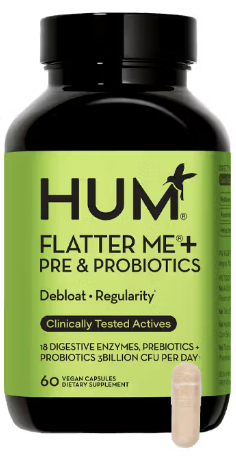
Flatter Me Plus + Pre & Post Probiotics
Hum Nutrition
Last updated: Sep 30, 2026
Clinically studied formula with 18 full-spectrum digestive enzymes plus pre- and probiotics help break down food for better digestion, reduces bloating + promotes regularity.*
BUY HERE
Note: When you buy a product through the links on our website, we may earn commission through affiliate programs.

Ingredients*
We only evaluate bioactive ingredients—the ones that truly contribute to a product's performance. Below is a list of bioactive ingredients found in this product.
For each ingredient, the quantity in parentheses indicates the amount per serving.
HUM Flatter Me® Proprietary Enzyme Blend contains: Protease 3.0 (15 SAPU), Protease 4.5 (20,000 HUT), Protease 6.0 (35,000 HUT), Peptidase (2,500 HUT), Bromelain (650,000 FCC PU), Neutral bacterial protease (20,000 PC), Papain (250,000 FCC PU), Lipase (350 FIP), Amylase (3,500 DU), Glucoamylase (5,3 AGU), Alpha-galactosidase (75 GalU),Invertase (150 SU). Diastase (325 DP°), Hemicellulase (1,250 HCU), Cellulase AN (200 CU), Beta-glucanase (10.6 BGU), Phytase (3.1 FTU), Lactase (150 ALU)
Protease 3.0 refers to a specific type of proteolytic enzyme designed to break down proteins into smaller peptides and amino acids. The number "3.0" typically indicates the enzyme's optimal pH range, which in this case suggests that it works best around pH 3.0, making it an acid-stable protease.
Protease 4.5 is a proteolytic enzyme that breaks down proteins into smaller peptides and amino acids. The "4.5" refers to its optimal pH range, meaning it works best around a pH of 4.5, which makes it effective in mildly acidic environments, such as the stomach.
Protease 6.0 is a proteolytic enzyme that breaks down proteins into smaller peptides and amino acids. The "6.0" refers to its optimal pH range, meaning it works best around a pH of 6.0, which is slightly acidic to neutral. This makes it highly effective in the small intestine and in various industrial processes.
Peptidase is an enzyme that specializes in breaking down peptides into smaller peptides and free amino acids. It plays a key role in protein digestion and various biological processes.
Bromelain is a powerful proteolytic enzyme (protein-digesting enzyme) primarily derived from the stem and fruit of the pineapple plant (Ananas comosus). It helps break down large protein molecules into smaller peptides and free amino acids, aiding in digestion and offering various therapeutic benefits.
Neutral Bacterial Protease is a proteolytic enzyme derived from bacteria, typically strains of Bacillus subtilis or Bacillus licheniformis. It functions optimally at a neutral pH (around 6.5-7.5), making it highly effective in various biological, industrial, and digestive applications.
Papain is a protease enzyme derived from the papaya fruit, specifically from the latex (milky sap) of the papaya tree. It is known for its ability to break down proteins into smaller peptides or amino acids, which is why it is commonly used as a meat tenderizer.
Lipase is an enzyme that catalyzes the breakdown of fats into glycerol and fatty acids.
Amylase can support digestion by breaking down starches into simpler sugars, helping with digestive issues, enzyme deficiencies, and blood sugar regulation.
Glucoamylase (5.3 AGU) is an enzyme that breaks down complex carbohydrates (like starch) into simple sugars, primarily glucose and plays a key role in processes like digestion, brewing, and industrial fermentation.
Alpha-galactosidase is an enzyme that helps break down complex carbohydrates, specifically oligosaccharides like raffinose and stachyose, which are found in foods such as beans, lentils, cruciferous vegetables, and whole grains. These carbohydrates are often hard to digest and can cause gas, bloating, and discomfort.
Invertase is an enzyme that breaks down sucrose (table sugar) into its simpler sugar components, glucose and fructose. This process is known as sucrose hydrolysis or inversion, and the resulting mixture is called inverted sugar syrup, which is sweeter and has different physical properties compared to sucrose.
Diastase is a group of enzymes that break down starch into simpler sugars like maltose and glucose.
Hemicellulase is an enzyme that breaks down hemicellulose, a complex carbohydrate (polysaccharide) found in the cell walls of plants. Hemicellulose is a major structural component in plant fibers, but unlike cellulose, it’s more easily broken down because of its branched structure.
Cellulase is an enzyme (or a group of enzymes) that breaks down cellulose, the main structural component of plant cell walls, into simpler sugars like glucose. Cellulose is a complex carbohydrate (polysaccharide) made up of long chains of β-1,4-linked glucose molecules, which are difficult for humans to digest without the help of enzymes like cellulase.
Beta-glucanase is an enzyme that breaks down beta-glucans, which are complex polysaccharides (carbohydrates) found in the cell walls of grains (like barley, oats, and wheat), as well as in yeasts, fungi, and certain bacteria. Beta-glucans are made up of β-1,3 and β-1,4 glycosidic bonds, which give them a gel-like, viscous texture that can be hard to digest without the help of enzymes.
Phytase is an enzyme that breaks down phytic acid (also known as phytate), a compound found in plant seeds, grains, legumes, and nuts. Phytic acid stores phosphorus in plants, but it can also bind to minerals like iron, zinc, calcium, and magnesium, reducing their absorption in the human gut. Phytase helps release these bound nutrients, making them more bioavailable.
Lactase is an enzyme that breaks down lactose, the natural sugar found in milk and dairy products, into its two simpler sugars: glucose and galactose. This is an essential enzyme for digestion, especially in infants, who rely on breast milk as a primary food source.
Flatter Me Plus Herbal Blend contains Ginger Root Powder, Fennel Seed Powder, Peppermint Leaf Powder
Ginger root powder is included in dietary supplements for its potential anti-inflammatory and antioxidant properties, which may provide various health benefits.
Fennel seed powder has the potential to support healthy digestion, reduce occasional bloating and gas, and promote gastrointestinal comfort with its natural aromatic compounds.
Peppermint leaf powder, has the potential to support digestive health, relieve occasional stomach discomfort, and promote a natural sense of cooling and refreshment due to its menthol content.
Inulin is a type of soluble fiber found in many plants, particularly in the roots, tubers, and rhizomes of plants like chicory, artichokes, onions, garlic, leeks, and asparagus. It is classified as a fructan, a carbohydrate made up of chains of fructose molecules, and is not digested by the human stomach or small intestine. Instead, it reaches the colon where it acts as a prebiotic.
Probiotic Blend contains Bacillus coagulans SNZ1969™, Bacillus subtilis DE111®)
Bacillus coagulans SNZ 1969 is a probiotic strain of bacteria that has been studied for its potential health benefits, particularly in relation to gut health. It is a spore-forming bacterium, which means it can survive harsh conditions like stomach acid and heat, making it more likely to reach the intestines alive.
Bacillus subtilis DE111® is a probiotic strain that has been clinically shown to support a healthy gut microbiome, and to promote digestive and immune health in both adults and children. It is a spore-forming probiotic, which means that it can survive the harsh conditions of the stomach and small intestine and reach the colon alive. DE111® is a registered trademark of Deerland Probiotics & Enzymes, Inc.
*These product and ingredient description statements have not been evaluated by the Food and Drug Administration (FDA). This product or its ingredients are not intended to diagnose, treat, cure or prevent any disease.
Product description and ingredient list are obtained from the product's brand/company website. Ingredient description is provided by our expert.
WhatToTrustTM Score
UNCOVER WhatToTrustTM SCORES AND SEARCH PRODUCTS BY CATEGORY.Search products

